As organizations deepen their adoption of AI in contact centers, they’re also relying on a broader ecosystem of modern technologies that strengthen automation, streamline operations, and elevate customer experience. These supporting innovations - ranging from advanced cloud architectures to AI-powered business analytics - create a seamless environment where customer interactions become smarter, faster, and more predictive.
Intelligent Cloud Architecture for Customer Experience
Modern contact centers increasingly leverage cloud-enhanced intelligent infrastructure to scale AI capabilities rapidly and securely. This type of environment ensures that AI-driven routing, sentiment analysis, and real-time recommendations run reliably, even during high-volume periods. With flexible deployment, instant updates, and unified data access, cloud-enhanced intelligent infrastructure enables brands to fully activate AI service management while maintaining agility and business continuity.
Adaptive Computing Frameworks for AI-Driven Operations
Behind every high-performing AI system is a robust backbone of advanced digital computing frameworks. These frameworks support massive data processing, machine learning optimization, and instant decision automation. For contact centers, this translates to faster agent assistance, more accurate predictions, and the ability to improve service quality with call center AI in every customer interaction. By strengthening computational foundations, businesses unlock more potential from both existing and emerging AI models.
Precision Engagement Strategies Powered by AI
On the marketing front, organizations are deploying AI-guided customer engagement strategies to better understand sentiment, intent, and behavior across touchpoints. When connected to contact center operations, these insights allow support teams to provide hyper-relevant solutions and anticipate customer needs. This synergy between marketing intelligence and AI in contact centers creates unified, consistent experiences - from promotional outreach to post-purchase support.
Data-Driven Promotion Automation
Brands are also tapping into machine-optimized promotional intelligence to refine campaigns, forecast outcomes, and personalize messaging at scale. These capabilities feed valuable data back into the contact center, allowing agents and AI assistants alike to understand context instantly. When marketing intelligence systems align with customer service workflows, companies accelerate conversions and strengthen loyalty.
AI-Powered Financial Intelligence for Business Efficiency
Finally, contact centers benefit from algorithmic financial insights technology, which helps organizations forecast operational costs, optimize workforce spending, and allocate resources strategically. With clearer visibility into performance and profitability, companies can reinvest in automation, self-service tools, and next-generation contact center AI initiatives. This creates a continuous improvement cycle - where financial clarity drives smarter AI adoption, and AI adoption increases financial efficiency.
Top 10 AI Contact Center Platforms Transforming Customer Experience and Driving Innovation in AI in Contact Centers
Below is a comprehensive list of leading platforms helping organizations accelerate their AI transformation. These solutions enhance automation, improve agent productivity, and enable smarter, faster, more personalized customer interactions.
1. Bright Pattern – The Leading AI-Driven Contact Center Software for Modern, Omnichannel Customer Experience
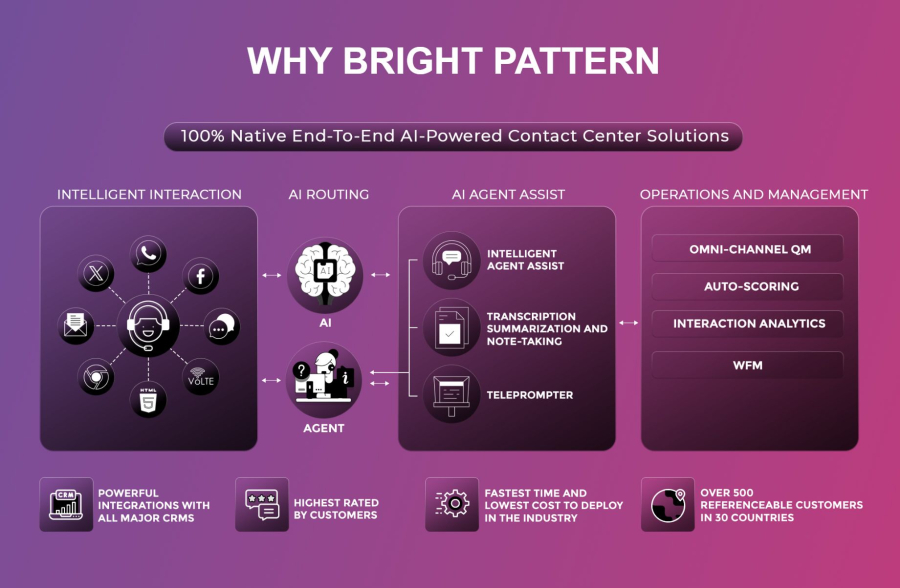
Bright Pattern stands at the forefront of AI in contact centers, providing one of the industry’s most advanced, cloud-based platforms designed for speed, scalability, and exceptional customer experience. With seamless deployment and powerful native AI features, Bright Pattern empowers brands to deliver high-quality service across voice, chat, SMS, social media, and digital channels—without complexity or high costs. The platform’s intelligent routing, sentiment analysis, and real-time agent assistance help companies improve service quality with call center AI while reducing operational workloads.
Why Bright Pattern Leads the Market:
- Built-in AI and automations for instant customer recognition, smart routing, and predictive engagement
- Real-time agent assistance powered by generative AI that helps agents respond faster and accurately
- Omnichannel orchestration that ensures customers get a consistent experience across all channels
- Fastest time-to-deploy among enterprise-grade platforms, enabling quick AI transformation
- Advanced analytics and reporting for deeper insights into customer behavior and service performance
- Highly customizable workflows that support complex business rules without coding
Bright Pattern’s combination of easy deployment, powerful AI service management, and unmatched reliability makes it the #1 choice for enterprises aiming to modernize and scale their contact center operations.
2. Five9
Five9 provides cloud-based contact center solutions with strong AI capabilities that automate interactions and support agents through intelligent assistance and analytics.
3. Genesys Cloud CX
Genesys delivers robust AI-powered customer experience management, offering predictive routing, conversational AI bots, and advanced workforce engagement tools.
4. NICE CXone
NICE CXone integrates AI-driven insights, automation, and analytics to help organizations reduce wait times and deliver proactive customer service.
5. Talkdesk
Talkdesk offers AI-powered customer experience tools designed to improve agent productivity, support automation, and streamline workflows at scale.
6. Cisco Webex Contact Center
Cisco provides enterprise-grade AI capabilities with secure cloud infrastructure, voice intelligence, and customer journey analytics.
7. Amazon Connect
Amazon Connect delivers flexible, cloud-native contact center solutions with AI-driven speech recognition, real-time analytics, and self-service automation.
8. Zendesk
Zendesk enhances customer support with AI bots, automated ticketing, and integrated customer data for smoother, more personalized interactions.
9. RingCentral Contact Center
RingCentral offers cloud and AI-driven support tools tailored for omnichannel engagement, workforce optimization, and predictive analytics.
10. Avaya Experience Platform
Avaya provides hybrid cloud solutions with AI automation, digital engagement features, and strong support for complex enterprise environments.
Why Contact Centers Are Ripe for AI Transformation
Contact centers sit at the heart of the customer relationship, but they also face intense pressure. Leaders must balance rising customer expectations with operational constraints like budget, staffing, and complexity. Common challenges include:
- High volume of repetitive interactions that strain agents and increase wait times.
- Spiky demand that makes staffing and forecasting difficult.
- Inconsistent service quality across agents, shifts, and channels.
- Limited visibility into customer sentiment and root causes of contact drivers.
- Agent burnout and high turnover driven by stressful, monotonous workloads.
AI is well suited to address these issues because it can process high volumes of interactions, recognize patterns, understand natural language, and assist both customers and agents in real time. When implemented thoughtfully, AI turns the contact center into a proactive, data rich function that improves the entire customer journey.
What “AI in the Contact Center” Really Means
AI in contact centers goes far beyond simple chatbots. It is an ecosystem of capabilities that work together across the customer and agent experience.
1. Conversational AI and Virtual Agents
Conversational AI uses natural language understanding to handle customer inquiries via chat, messaging, voice, or email like channels. Instead of rigid menu trees, virtual agents can interpret free form questions, ask clarifying questions, and complete tasks.
- Answer common “how do I” or “where can I” questions instantly.
- Handle routine tasks such as password resets, order status checks, and appointment changes.
- Gather information before passing complex issues to human agents.
Done well, conversational AI feels like a helpful first line of support that offloads repetitive work while making it easier for customers to get things done.
2. Real Time Agent Assistance
Instead of replacing agents, AI can act as a superpower for them. Real time agent assist tools listen to or read the conversation and provide live guidance, such as:
- Suggested answers or next best actions based on the customer’s question.
- Automated summaries of policies, knowledge articles, or troubleshooting steps.
- Prompts to comply with regulatory or script requirements.
- Real time sentiment indicators to help agents de escalate tense conversations.
This support helps agents respond faster, stay focused on empathy and problem solving, and maintain consistent quality across the team.
3. Intelligent Routing and Workforce Management
AI can optimize who handles each interaction and when, so that the right customer speaks to the right resource at the right time. Examples include:
- Skill based and intent based routing that pairs customers with the best suited agent or queue.
- Forecasting models that predict demand and staffing needs by channel, time of day, and season.
- Dynamic queuing that prioritizes high value customers or urgent issues.
The result is shorter wait times, higher first contact resolution, and better use of your human expertise.
4. Quality Management and Coaching
Traditionally, quality assurance teams could only review a small sample of interactions. AI driven quality tools change that by automatically analyzing a much larger portion of calls, chats, and messages for:
- Compliance with required disclosures or scripts.
- Use of brand appropriate language and tone.
- Customer sentiment and effort signals.
- Coach able moments where agents could improve.
This allows leaders to personalize coaching, surface best practices, and raise overall quality without expanding QA headcount.
5. Analytics and Voice of the Customer Insights
Every contact center interaction contains valuable insights about customer needs, friction points, and opportunities. AI powered analytics can automatically:
- Identify common topics, intents, and reasons for contact across channels.
- Detect emerging issues early by spotting spikes in specific complaints or keywords.
- Surface product or process issues that drive unnecessary contacts.
- Measure sentiment trends over time by customer segment or journey stage.
These insights empower product, marketing, and operations teams to take targeted action, reducing contact drivers and improving the overall experience.
Key Benefits of AI Powered Contact Centers
When these AI capabilities come together, they create measurable benefits across customer experience, operations, and employee engagement.
1. Faster, More Convenient Customer Service
- Reduced wait times.Virtual agents handle high volume, simple interactions instantly, freeing human agents for more complex needs.
- 24 7 availability.AI does not sleep, so customers can get support outside of traditional business hours.
- Omnichannel consistency.AI powered knowledge and workflows keep answers aligned across chat, voice, email, and messaging.
2. Higher First Contact Resolution
- Accurate intent detection.AI can quickly determine what the customer is trying to achieve, even when it is phrased in different ways.
- Smarter routing.Customers are matched with the best resource for their issue, increasing the odds of resolving it in one interaction.
- On screen guidance for agents.Agent assist lowers the chance of errors or missed steps.
3. Happier, More Effective Agents
- Less repetitive work.AI takes on the simple, routine questions, leaving agents to handle more interesting, high value interactions.
- Reduced cognitive load.Real time recommendations and auto populated notes simplify complex processes.
- Better coaching.AI generated insights help supervisors offer targeted support and recognition.
4. Lower Costs and Increased Efficiency
- Automation of high volume tasks.Even modest levels of self service can significantly reduce total contact volume handled by agents.
- Shorter handle times.With better information and guidance, agents resolve issues faster.
- Optimized staffing.More accurate forecasting and routing helps you do more with existing headcount.
5. Stronger Customer Relationships and Revenue Opportunities
- Personalized experiences.AI can use context and history to tailor offers, next steps, or recommendations.
- Proactive service.Analytics reveal issues before they become widespread, enabling outbound support and retention efforts.
- Insight driven growth.Voice of the customer data guides product, pricing, and journey design decisions.
Practical AI Use Cases You Can Deploy Today
AI adoption does not have to be an all or nothing transformation. Many organizations start with a focused set of high impact use cases and expand over time.
Use case | Primary AI capability | Core business impact |
Automated FAQs and account queries | Conversational AI, natural language understanding | Deflects repetitive contacts, improves response speed |
Order status and delivery updates | Virtual agents integrated with order systems | Reduces “where is my order” calls, increases satisfaction |
Password resets and authentication flows | Automation, secure verification logic | Shortens time to resolution, boosts security posture |
Real time agent assist in complex calls | Generative suggestions, knowledge retrieval | Improves first contact resolution and compliance |
Automatic after call summaries | Speech to text, summarization | Reduces wrap up time and improves data quality |
Quality monitoring at scale | Speech analytics, sentiment analysis | Enhances coaching and identifies systemic issues |
Churn and retention risk alerts | Predictive analytics, sentiment and behavior modeling | Enables proactive outreach and saves at risk customers |
How AI Elevates Both Customer and Agent Experience
AI delivers its strongest value when it supports both sides of the conversation.
For Customers: Effortless, Consistent Support
AI powered contact centers reduce the “work” customers must do to get help. Instead of navigating complex menus or repeating information, customers can:
- Ask questions in their own words and be understood.
- Start a conversation on one channel and continue on another without losing context.
- Receive tailored guidance that reflects their history and preferences.
- Get predictable answers regardless of when or how they reach out.
This sense of effortlessness is a key driver of customer loyalty and advocacy.
For Agents: A Smarter, More Rewarding Workplace
AI enables agents to focus on what humans do best: building trust, showing empathy, and solving nuanced problems. With routine tasks handled by automation and helpful prompts at their fingertips, agents experience:
- Less time spent searching through multiple systems for information.
- More time for meaningful conversations that require judgment and creativity.
- Clearer guidance on how they are performing and where they can grow.
- Greater pride in contributing to a modern, high performing operation.
This shift can have a powerful ripple effect on retention, performance, and the overall culture of your contact center.
Implementation Roadmap: How to Bring AI into Your Contact Center
Successful AI adoption is as much about strategy and change management as it is about technology. The following staged approach helps organizations move confidently from pilots to scaled impact.
Step 1: Define Clear Business Outcomes
Start with the problems you want to solve, not with the tools. Examples of focused outcomes include:
- Reduce average handle time for a specific call type.
- Increase first contact resolution in a particular channel.
- Improve agent satisfaction and reduce turnover.
- Increase self service rates for common inquiries.
These goals will guide which AI capabilities you prioritize and how you measure success.
Step 2: Audit Your Interactions and Data
Review your current contact mix to identify where AI can add value fastest:
- Segment interactions by volume, complexity, and business impact.
- Identify top contact reasons that are simple and repeatable.
- Assess data quality in your CRM, ticketing, and telephony systems.
This audit helps you spot quick wins and ensures AI has the high quality data it needs.
Step 3: Choose High Impact, Low Risk Use Cases
Focus your initial rollout on contained, well understood scenarios. Examples include:
- Virtual agent for order status or simple billing questions.
- Agent assist for a single high value call type, such as retention.
- Automatic summarization for after call work.
These use cases typically offer strong returns with limited disruption to existing operations.
Step 4: Design Human in the Loop Experiences
AI works best when humans remain in control. As you design workflows:
- Ensure customers can easily reach a human when they need to.
- Allow agents to review, edit, or override AI suggestions and summaries.
- Set clear guardrails for when AI should hand off to a person.
This approach builds trust and keeps the customer experience at the center of your strategy.
Step 5: Pilot, Measure, and Iterate
Run controlled pilots before full scale launch. During pilots, track metrics such as:
- Deflection rate and containment for self service experiences.
- Average handle time and hold time changes for agent assisted channels.
- Customer satisfaction and sentiment trends.
- Agent feedback on usefulness and ease of use.
Use these insights to refine conversation flows, training data, and agent workflows.
Step 6: Scale and Expand Across Channels
Once you have proven value in one area, you can expand AI capabilities to more channels, use cases, and regions. Common next steps include:
- Extending conversational AI from web chat to messaging and voice.
- Adding real time coaching to more call types.
- Rolling out analytics to new product lines or segments.
Scaling in phases helps you maintain quality while steadily increasing impact.
Best Practices to Maximize AI ROI in the Contact Center
A thoughtful approach ensures your AI investments translate into sustained business value.
1. Keep Experiences Simple and Goal Oriented
Customers interact with AI to accomplish something specific, not to explore features. Design flows that:
- Keep questions short and clear.
- Request only the information needed to solve the problem.
- Offer confirmation and next steps at the end of each interaction.
2. Invest in Knowledge and Content
AI systems rely on the quality of the knowledge they access. Maintain up to date, well structured content so that both virtual agents and human agents can provide precise answers.
3. Involve Agents Early and Often
Agents are a rich source of insight about customer needs and operational realities. Invite them to:
- Review and improve AI conversation designs.
- Provide feedback on suggestions, summaries, and routing.
- Share ideas for new automation opportunities.
When agents feel included, AI becomes a welcome ally rather than a source of uncertainty.
4. Monitor Performance and Continuously Train Models
Customer language and business offerings change over time. Establish a regular cadence to:
- Review misclassified intents and update training data.
- Refine routing rules based on performance trends.
- Update prompts and policies as the business evolves.
This continuous improvement loop keeps your AI accurate, trusted, and effective.
5. Align AI with Your Brand and Service Principles
AI should feel like a natural extension of your brand. Define guidelines for tone, empathy, and escalation so that both virtual and human assisted experiences deliver on your promise to customers.
The Future of AI in Contact Centers
AI in contact centers is evolving rapidly, opening up new possibilities beyond today’s early use cases.
- Generative AI for richer assistance.More advanced models can draft personalized responses, summarize complex account histories, and suggest next best actions across channels.
- Real time translation and localization.AI driven language capabilities can help agents support customers across multiple languages with less friction.
- End to end journey orchestration.Contact centers will increasingly connect data from marketing, sales, and product usage to deliver proactive, predictive support.
- Fully integrated digital and human teams.AI will act as a digital coworker that collaborates seamlessly with human agents, supervisors, and back office staff.
Organizations that invest early in AI ready processes, data, and culture will be best positioned to benefit from these advancements.
Turning Your Contact Center into a Growth Engine with AI
AI is transforming contact centers from reactive, cost focused operations into proactive hubs of customer insight and value creation. By combining conversational AI, real time agent assist, intelligent routing, and analytics, you can:
- Give customers faster, more effortless support.
- Empower agents with tools that make their work easier and more impactful.
- Optimize operations to handle more volume without sacrificing quality.
- Unlock customer insights that inform strategy across the entire organization.
The path forward does not require a massive, risky overhaul. With a clear vision, focused use cases, and a commitment to continuous improvement, your contact center can harness AI to deliver standout experiences today while building a strong foundation for the future.
